Lymph Savior Official Website › Blog › Red root
What Is Red Root in Lymphsavior? A Traditional Herb and Its Two Papers
Red root is on this label because herbal tradition classes it as a lymphatic herb. Its entire footprint in the medical literature is two papers: a note from 1868 and a laboratory study from 1997 about tooth decay. This is what searching for its evidence actually turns up.
- Red root is Ceanothus americanus, a North American shrub also called New Jersey tea.
- Its whole PubMed footprint is two records, one from 1868 and one from 1997.
- Neither is a clinical trial. Neither is about lymphatic flow.
- There is no randomised evidence for it in any condition, at any dose.
- That is a real gap, and printing it is more useful than an adjective.
What red root is
Ceanothus americanus is a low shrub native to eastern North America, with white flower clusters and a thick red root that gives it its common name. Its other common name, New Jersey tea, comes from its leaves being brewed as a caffeine-free substitute during the American Revolution when imported tea was boycotted.
In North American herbal practice it has a long and specific reputation. It is classed as a lymphatic herb, used traditionally for swollen glands and as what older texts call an alterative, a word describing a herb thought to restore normal function gradually rather than to act on a symptom directly.
That reputation is the reason it appears on a lymphatic support formula, and it is worth being precise about what kind of reason that is.
What a search for its evidence returns
A supplement page that says a botanical is traditionally used is doing one of two things: reporting that nobody has studied it, or hoping nobody checks. The way to tell the difference is to check.
Searching the PubMed index for Ceanothus americanus returns two records. Not two trials, not two reviews. Two records, in total, across the whole indexed medical literature.
| Record | Year | What it is | Relevant to lymphatic flow? |
|---|---|---|---|
| Ceanothus Americanus: Red Root, New Jersey Tea | 1868 | A note in the Atlanta Medical and Surgical Journal | Not measurably |
| Antimicrobial compounds from Ceanothus americanus against oral pathogens | 1997 | A phytochemistry paper from a dental research institute | No |
That is the complete list. A search returning two items, one of them from the nineteenth century, is itself the most informative thing about this ingredient.
The 1868 note
The first record is a note by D. L. Phares in the Atlanta Medical and Surgical Journal, published in 1868. It is indexed, it is real, and it is a period document rather than a study: a nineteenth-century practitioner describing a plant and what it was used for.
It is worth reading as history rather than as evidence, and it is cited here for exactly that reason. A reader who wants to know what stands behind the phrase traditionally used for lymphatic support can now see the oldest indexed instance of it and judge for themselves.
What it is not is a trial, a dose-finding study, or a measurement of anything. No modern paper has tested its claims.
The 1997 laboratory paper
The second record comes from the Dows Institute for Dental Research at the University of Iowa, published in Phytochemistry in 1997. It isolated antimicrobial compounds from the plant and tested them against the bacteria behind tooth decay and gum disease.
It is real science and it is good work. It is also, on any honest reading, about dentistry. It says nothing about fluid, swelling, nodes or lymphatic transport, and it was never intended to.
Two things follow. The plant does contain identifiable bioactive compounds, which is not nothing. And the only laboratory work anybody has published on those compounds was pointed in a completely different direction from the one this label implies.
- No randomised controlled trial of red root exists, in any condition.
- No dose-finding work exists, which is part of why no amount could be meaningfully printed even if the label carried a panel.
- No standardisation marker is established, unlike escin for horse chestnut.
- No safety literature of any size exists either, which cuts both ways: no signal has been reported, and nobody has looked.
See what else is in the Lymph Savior formula
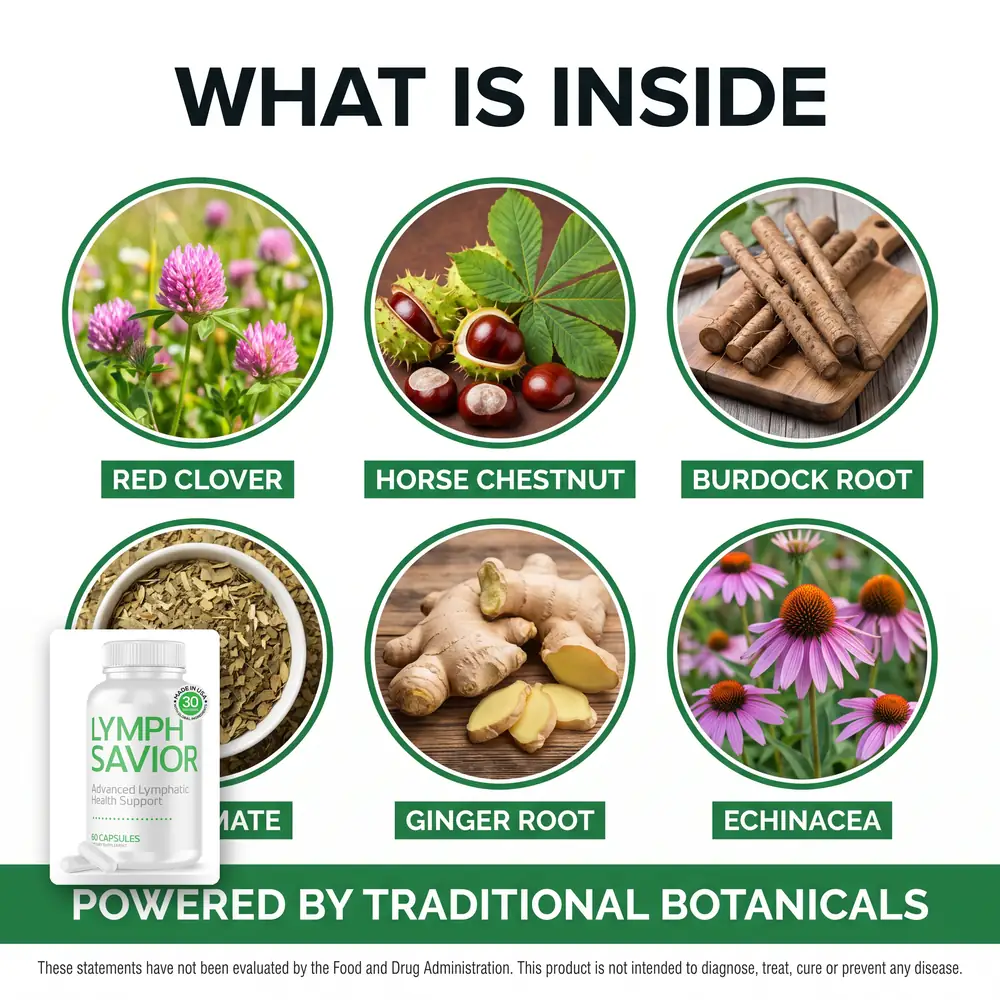
Six botanicals, two with randomised trials in a condition involving leg fluid and two that rest on tradition. The ingredients page sets out each one with its sources attached.
One, three and six-bottle packs · price set at checkout · 60-day money-back guarantee
Order Lymph Savior From This OutletLot LYM-26/LY-5684 · two a day, 60 to a bottle · ships from the United States
What tradition is and is not evidence of
This is the part worth being careful about, because the two easy positions are both wrong.
Traditional use is evidence of use. It tells you that people have taken a plant for a long time, which carries some weak information about tolerability: a herb that poisoned people reliably tends not to survive two centuries of use. It carries almost no information about efficacy, because the conditions it was used for were not measured and the outcomes were not recorded.
Dismissing it entirely is equally unserious. Several standard medicines began as traditional preparations, and the plants that turned out to do something were found by studying them rather than by ignoring them. The NCCIH herb index exists to hold both ideas at once, and its guidance on using supplements sensibly is a reasonable thing to read before buying anything in this aisle.
The honest description of red root is therefore narrow. It is a plant with a long and specific traditional reputation in exactly the area this product is sold for, and with no modern evidence behind that reputation at all.
Why it is still on the label
Two reasons, one defensible and one commercial, and it is worth separating them.
The defensible one is that a formula built in the North American herbal tradition would look odd without it. Red root is what that tradition reaches for when the subject is lymphatic, in the way horse chestnut is what the European tradition reaches for when the subject is heavy legs. A blend assembled from that tradition includes it almost by definition.
The commercial one is that the name does work on a label. Red root sounds purposeful, it is unusual enough to look considered, and very few buyers will search it.
Both are probably true at once. What a reader can do with that is weight the ingredient list honestly: on this bottle, two of six botanicals carry randomised human evidence, one carries a large literature in an unrelated indication, one carries caffeine, and two carry tradition. Red root is the clearest of the two.
The system it is traditionally aimed at is described in the modern physiology literature in considerable detail, and none of that literature mentions this plant.
Burdock, the other tradition-only botanical here
Red root is not alone on this label in resting on tradition rather than on trials. Burdock root is in the same position, and comparing the two is instructive because the gap between them is larger than it looks.
Arctium lappa has a substantial modern literature. It has been studied for its polyphenols, its flavonoids and the fructo-oligosaccharides in its root, and there is a body of animal work on liver protection, blood sugar and lipids. What it does not have is a human trial in anything resembling the use case on this bottle.
So burdock sits a step above red root and a step below horse chestnut. Somebody has characterised the plant and knows what is in it; nobody has given it to people and counted anything relevant.
| Botanical | Characterised chemistry? | Animal work? | Human trials in a relevant condition? |
|---|---|---|---|
| Horse chestnut seed | Yes, standardised to escin | Yes | Yes, pooled in a Cochrane review |
| Centella asiatica | Yes, triterpenes | Yes | Yes, eight studies, risk of bias unclear |
| Burdock root | Yes | Yes | No |
| Red root | Two compounds, in one 1997 paper | No | No |
Four rows, four different positions. A label that prints six names in one list conceals every one of these distinctions.
The practical use of that table is comparison shopping. A blend that pairs a well-characterised botanical with three uncharacterised ones is a different proposition from one built entirely on the first kind, and the ingredient list alone does not tell you which you are holding.
It also explains something about how these formulas get built. A traditional category, in this case the alteratives, supplies a list of candidate plants. Some of those plants have since been studied and some have not, and the studying happened for reasons that had nothing to do with the tradition: horse chestnut was investigated because European clinicians were already prescribing it for heavy legs, and centella because its wound-healing reputation attracted pharmaceutical interest in the 1960s.
Red root attracted none of that. It is not that the plant failed a test; it is that nobody ran one, which is a different thing and is worth stating in those words rather than in the vaguer ones the category prefers.
When a supplement page says traditionally used, search the plant name. Two records and a nineteenth-century journal is a specific answer, and it is worth more than any adjective either way. The NIH consumer factsheet is a good place to start on what supplement evidence generally looks like.
References
- Phares DL. Ceanothus Americanus: Red Root, New Jersey Tea. Atlanta Medical and Surgical Journal. 1868;9A(3):129-131. https://pubmed.ncbi.nlm.nih.gov/35824507/
- Li XC, Cai L, Wu CD. Antimicrobial compounds from Ceanothus americanus against oral pathogens. Phytochemistry. 1997;46(1):97-102. https://pubmed.ncbi.nlm.nih.gov/9276981/
- Herbs at a Glance. National Center for Complementary and Integrative Health, National Institutes of Health. https://www.nccih.nih.gov/health/herbsataglance
- Using Dietary Supplements Wisely. National Center for Complementary and Integrative Health, National Institutes of Health. https://www.nccih.nih.gov/health/using-dietary-supplements-wisely
- Dietary Supplements: What You Need to Know. Office of Dietary Supplements, National Institutes of Health. https://ods.od.nih.gov/factsheets/WYNTK-Consumer/
- Breslin JW, Yang Y, Scallan JP, Sweat RS, Adderley SP, Murfee WL. Lymphatic Vessel Network Structure and Physiology. Comprehensive Physiology. 2018;9(1):207-299. https://pubmed.ncbi.nlm.nih.gov/30549020/