Lymph Savior Official Website › Blog › Two graphics, one formula
Two Graphics, One Formula: Where The Lymph Savior Artwork Disagrees With Itself
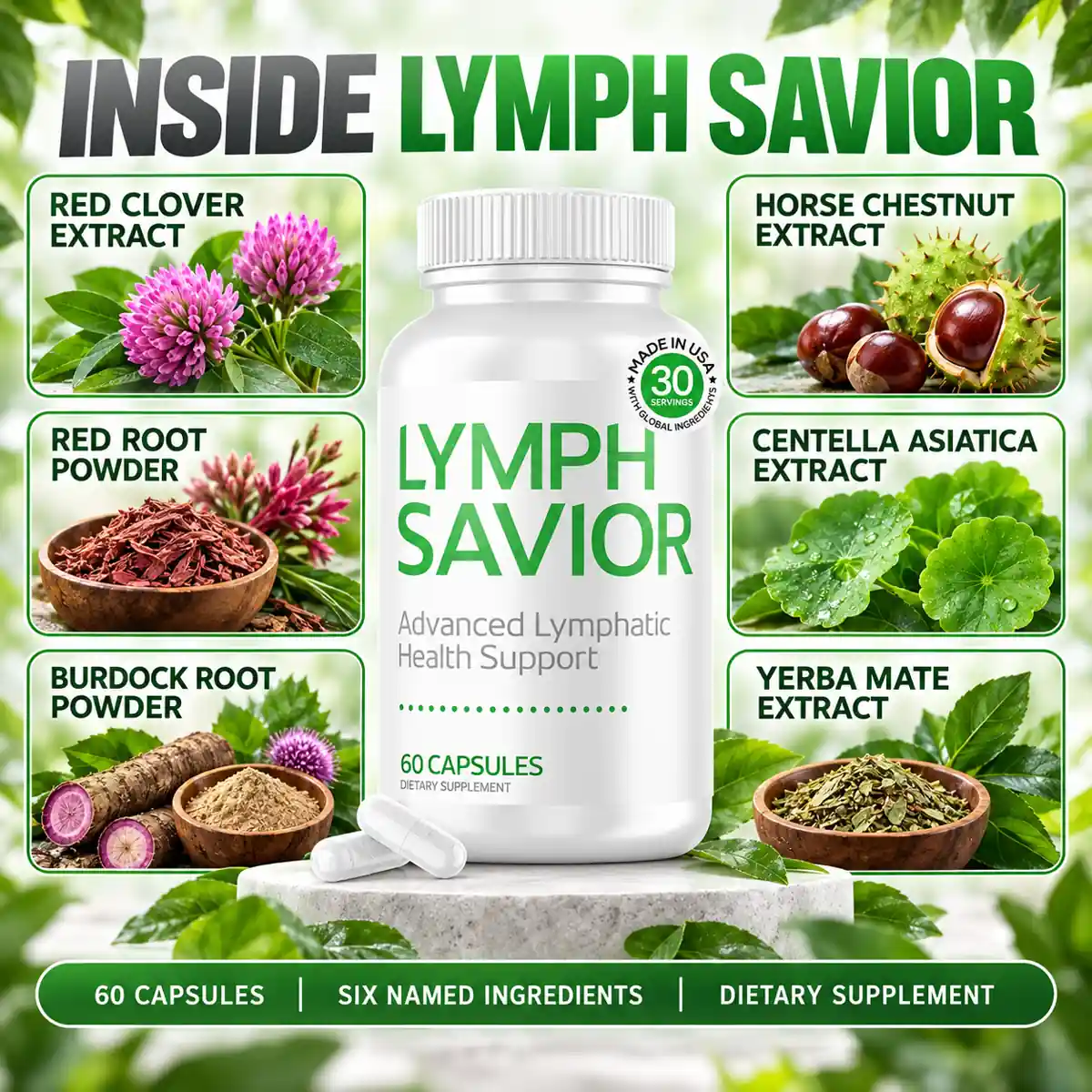
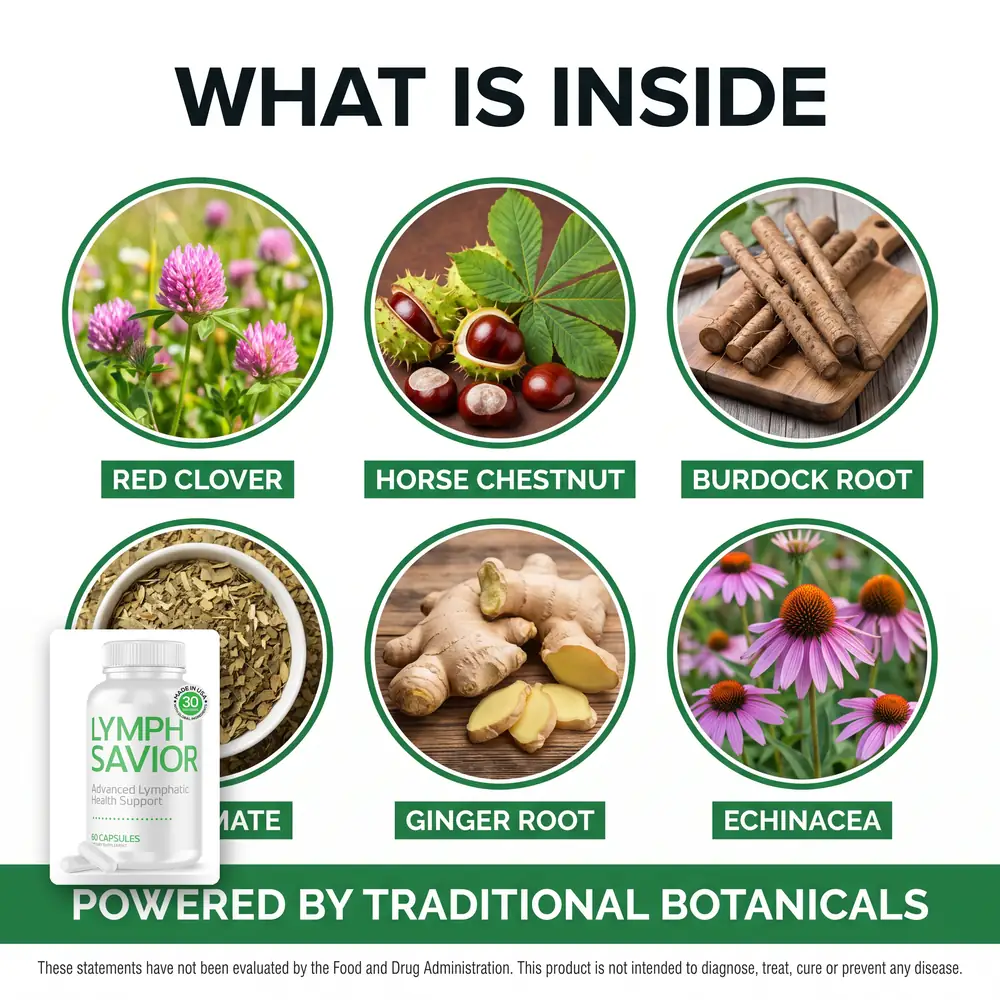
This pack did not ship with one ingredient graphic. It shipped with two. Set side by side, four of the six botanical names match exactly and two do not: the graphic headed INSIDE LYMPH SAVIOR names Red Root Powder and Centella Asiatica Extract, and the graphic headed WHAT IS INSIDE replaces both with Ginger Root and Echinacea. This is what that disagreement is, how it most likely happened, and what a reader should actually do with it.
- Two ingredient graphics were supplied with this pack. Four of six names match between them; two do not.
- One graphic names Red Root Powder and Centella Asiatica Extract. The other names Ginger Root and Echinacea in those same two positions.
- The sales page agrees with the first graphic, so that is the list this website treats as the formula.
- Ginger and echinacea appear on no other Lymph Savior material and are treated here as artwork errors, not as ingredients.
- A mismatch between two pieces of a manufacturer's own marketing set is a legitimate reason to double-check a product before buying it, on this bottle or any other.
Two graphics, one product
Every item on this site that describes the formula traces back to artwork supplied with the Lymph Savior pack, because the bottle itself carries no Supplement Facts panel and no ingredient list on the container. That much is true of every botanical this desk has written about. What is specific to this article is that the pack contained two separate graphics whose job was to answer the same question — what is inside the capsule — and they do not give the same six answers.
The first is a square tile headed INSIDE LYMPH SAVIOR, built around a centre photograph of the bottle with three ingredient photographs down each side. The second is a square tile headed WHAT IS INSIDE, built around six circular photographs in two rows of three, each captioned underneath. Both carry the same FDA disclaimer line. Both carry the Lymph Savior wordmark and the Advanced Lymphatic Health Support strapline. Neither is marked as a draft, a superseded version, or an international variant. They simply disagree.
Where the two lists agree
Before getting to the disagreement, it is worth being precise about how much the two graphics actually share, because four of six names is a genuine majority and it would be unfair to describe this pack as chaotic. Red Clover, Horse Chestnut, Burdock Root and Yerba Mate (the second graphic labels it simply Mate) appear in both, worded almost identically and illustrated with recognisably the same plant each time: clover blossom, a split spiny seed case, cut and powdered root, and dried cut leaf in a wooden bowl.
| Named on INSIDE LYMPH SAVIOR | Named on WHAT IS INSIDE | Agree? |
|---|---|---|
| Red Clover Extract | Red Clover | Yes |
| Horse Chestnut Extract | Horse Chestnut | Yes |
| Burdock Root Powder | Burdock Root | Yes |
| Yerba Mate Extract | Mate | Yes |
| Red Root Powder | Ginger Root | No |
| Centella Asiatica Extract | Echinacea | No |
Four rows agree, two do not. The disagreement is not spread thin across the formula; it sits entirely in two of the six positions.
Where they stop agreeing
The two positions that disagree are not minor. Red Root Powder becomes Ginger Root, illustrated with a hand of fresh ginger rhizome rather than the cut, reddish-brown root shown on the first graphic. Centella Asiatica Extract becomes Echinacea, illustrated with a purple coneflower in bloom rather than the small, round, water-drop-beaded leaves the first graphic shows. These are not close substitutions of a similar plant under a different name — ginger and echinacea are botanically and visually distinct from red root and centella, and a reader who has seen either plant before would notice the swap immediately.
Which column this website prints, and why
Lymphsavvior's own sales page lists the six botanicals the same way the first graphic does: Red Clover, Horse Chestnut, Red Root, Centella Asiatica, Burdock and Yerba Mate. That agreement between the sales page and one of the two graphics is the deciding fact. Two independent pieces of the same seller's own material naming the same six plants outweighs one graphic naming a different two, so this website's ingredients page, side-effects page and every article on this blog describe the formula as red clover, horse chestnut, red root, centella asiatica, burdock and yerba mate. The second graphic is treated as the outlier, not as a second valid formula to average against the first.
That is an editorial decision, not a laboratory one. Nobody at this desk has tested a capsule for ginger or echinacea content, and nobody is in a position to. The decision rests entirely on counting: two sources agree on one list, one source names a different pair, and the sales page is the document that actually governs what a buyer is agreeing to purchase.
What it means that ginger and echinacea are not in this formula
Because this website treats the sales page and the first graphic as the record, ginger and echinacea are written up here as names that appear on one piece of artwork and nowhere else in Lymph Savior's own materials — not on the sales page, not on the bottle front, not in the second graphic's own company. Readers who came to this page specifically to check on ginger's or echinacea's safety profile, an interaction, or a dosing question should look elsewhere for that information, because according to every other document this outlet can read, neither plant is actually in the capsule. The point this article is making is about the mismatch itself, not about either plant's pharmacology.
How two ingredient graphics end up disagreeing
Supplement brands commission marketing artwork in batches, often from different designers or different agencies working from a shared brief, and often across several product launches at once. A brief for a six-botanical "lymphatic support" formula and a brief for a six-botanical "immune and digestive support" formula are structurally identical files — six circular ingredient photos, a caption under each, the same badge row, the same disclaimer block — and differ only in which six plants are named. If a template built for one formula is reused for another and only some of the captions are updated before the file is approved and shipped to an outlet, the result is exactly this: a graphic that is internally consistent, professionally produced, and wrong in two of six places.
Nothing in the appearance of either graphic distinguishes the correct one from the templated one. Both carry the same disclaimer, the same bottle photography, the same brand colours. The only way to catch the error is to compare the graphic against an independent source — the sales page, the bottle, or a second graphic — the way this article does, rather than trusting any single piece of marketing artwork on its own.
What to do with a mismatch like this, on any product
This is not a problem unique to Lymph Savior, and the useful habit here generalises to any supplement bought from marketing images rather than from a legible label. Three checks catch most versions of this error before money changes hands.
- Read the sales page's own ingredient list first, and treat it as the primary document. Marketing images are illustrations of that list, not independent sources of truth.
- If more than one ingredient graphic is shown anywhere in the listing, compare them name for name. A single mismatched word is easy to miss when each graphic is viewed on its own and easy to catch the moment they are placed side by side, which is the comparison this article has just done.
- If the product ships with a legible Supplement Facts panel, that panel is the single most authoritative document available and should resolve any conflict between marketing graphics outright. This pack's images do not include one, which is covered in full on the ingredients page.
The FDA's own supplement labelling guidance exists precisely because the statement of identity and the ingredient declaration are supposed to be stable, checkable facts about a product rather than artwork that varies from file to file, and the FTC's compliance guidance for health products treats a marketer's own claims as something sellers are expected to be able to substantiate consistently across their materials. Two graphics from the same pack naming different plants in the same two positions is the kind of inconsistency those standards are written to prevent, even when — as appears to be the case here — the explanation is more likely a template reused in a hurry than any attempt to mislead.
See the Lymph Savior formula this website actually prints
Six botanicals, named the way the sales page names them, with the trial literature or the lack of it set beside each one.
One, three and six-bottle packs · price set at checkout · 60-day money-back guarantee
Order Lymph Savior From This OutletLot LYM-26/LY-5684 · two a day, 60 to a bottle · ships from the United States
What this mismatch does not tell you
It is worth being just as careful about what this finding does not establish as about what it does. It does not mean the capsule itself contains ginger or echinacea; nothing in the bottle's own printing supports that, and the weight of the available evidence (sales page plus one graphic, against one graphic) points the other way. It does not mean the six-botanical list this site uses is wrong; it means that list has independent support from two sources rather than one. And it does not tell a buyer anything about whether red clover, horse chestnut, red root, centella asiatica, burdock or yerba mate do what the strapline implies — that question is answered, botanical by botanical, on the ingredients page and is untouched by which graphic is correct.
What it does establish, cleanly, is that at least one piece of this seller's own marketing material was produced carelessly enough to misname two of six ingredients, and that a reader relying on a single image rather than cross-checking against the sales page could have walked away with the wrong idea of what this product contains. That is a fact about quality control in the marketing pipeline, not a fact about the capsule, and the two should not be confused with each other.
Two ingredient graphics shipped with this pack, and they disagree on two of six names. The sales page breaks the tie, and the lesson travels: compare, don't trust a single picture.
References
- Dietary Supplement Labeling Guide. U.S. Food and Drug Administration. https://www.fda.gov/food/dietary-supplements-guidance-documents-regulatory-information/dietary-supplement-labeling-guide
- Health Products Compliance Guidance. U.S. Federal Trade Commission. https://www.ftc.gov/business-guidance/resources/health-products-compliance-guidance
- Dietary Supplements: What You Need to Know. Office of Dietary Supplements, National Institutes of Health. https://ods.od.nih.gov/factsheets/WYNTK-Consumer/
- Using Dietary Supplements Wisely. National Center for Complementary and Integrative Health, National Institutes of Health. https://www.nccih.nih.gov/health/using-dietary-supplements-wisely