Lymph Savior Official Website › Blog › The horse chestnut evidence
Does the Horse Chestnut Research Apply to Lymphsavior? The Blend Question
Horse chestnut seed extract has a Cochrane review behind it, and that review says in its own selection criteria that it excluded trials of the extract inside a combination product. Lymph Savior is six botanicals in one capsule. This is what that means and what it does not mean.
- Six placebo-controlled trials covering 502 people found a mean reduction in leg volume of 32.1 mL with horse chestnut seed extract.
- Six of seven trials measuring leg pain found it fell, and one trial suggested the extract did about as well as compression stockings.
- Every one of those trials used horse chestnut ALONE. The review excluded combination preparations explicitly.
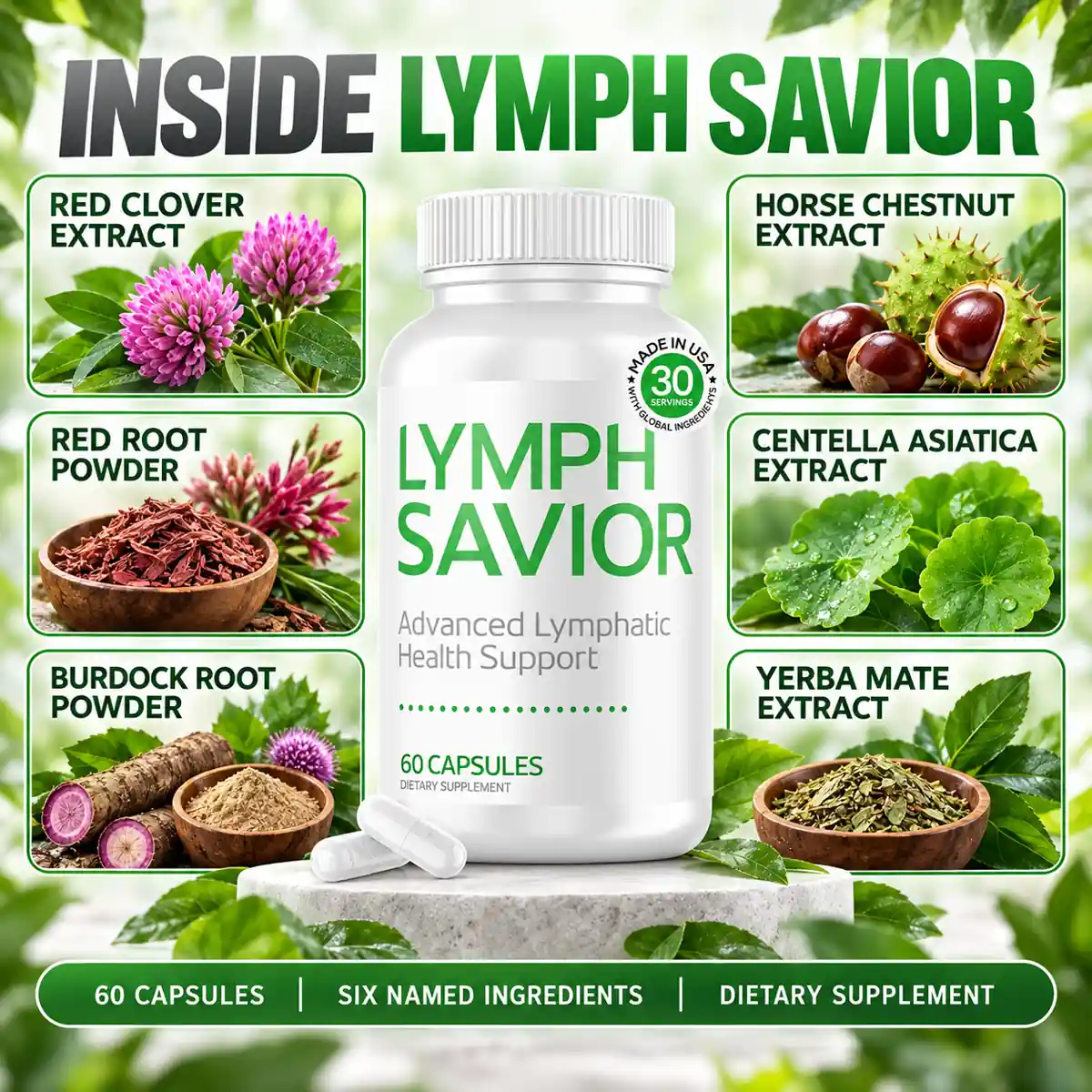
- This bottle contains six botanicals with no amount printed for any of them.
- That does not make the product useless. It means the Cochrane number is not this product's number.
What the Cochrane review actually found
Start with the finding, because it is genuinely good by the standards of this aisle.
The 2012 Cochrane review of horse chestnut seed extract for chronic venous insufficiency pooled the randomised evidence and reported an improvement in the signs and symptoms of the condition against placebo. Leg pain was assessed in seven placebo-controlled trials, six of which found a significant reduction. Leg volume was assessed in seven, and six of those, covering 502 people, produced a weighted mean difference of 32.1 mL in the extract's favour.
One trial went further and indicated the extract may be about as effective as compression stockings, which in a field where compression is the standard conservative care is a striking comparison to be able to make at all. The review called the adverse events usually mild and infrequent.
An earlier meta-analysis from 2002 reached a compatible place from a wider base: thirteen randomised trials covering 1,051 patients alongside three observational studies covering 10,725, with leg volume reduced by 46.4 mL against placebo and no severe adverse events reported.
So the ingredient is not a makeweight. Among the things sold for heavy, aching, swelling legs, horse chestnut seed extract is close to the best-evidenced botanical there is, which is why the NCCIH page on it is unusually specific for a herb entry.
The sentence in the selection criteria
Now the part almost nobody quotes.
A systematic review has to decide what counts. The Cochrane authors wrote their inclusion rule as randomised trials comparing oral horse chestnut seed extract MONO-PREPARATIONS with placebo or reference therapy, and they stated the exclusion in the same breath: trials assessing the extract as one of several active components in a combination preparation, or as part of a combination treatment, were excluded.
That is not a technicality buried in an appendix. It is the definition of what the 32.1 mL figure describes. The number belongs to a single standardised extract, taken on its own, at a stated dose, in people with a diagnosed condition.
| What the Cochrane result describes | What this bottle is |
|---|---|
| Horse chestnut seed extract on its own | One of six botanicals in a capsule |
| A stated daily dose in every included trial | No amount printed for anything |
| A standardised preparation, normally to a percentage of escin | No standardisation percentage anywhere on the artwork |
| People with diagnosed chronic venous insufficiency | Sold for everyday lymphatic support in healthy adults |
| Measured outcomes: leg volume, leg pain, ankle circumference | No outcome measured, because the finished product has never been trialled |
Five rows, five differences. Each on its own would be a reason for caution; together they are the reason this article exists.
Why a blend does not inherit a result
There are three separate reasons, and they compound.
The amount is unknown. A trial result is a result at a dose. Without a printed amount there is no way to know whether this capsule carries a trial-sized quantity of horse chestnut extract or a token one, and the honest answer is that the label does not permit the question to be answered at all.
The preparation is unknown. Extract is not a specification. The trials used preparations standardised to a marker compound, and a percentage is what converts an extract weight into an active amount. This label prints neither figure.
Six things in one capsule is a different intervention. Botanicals interact with each other and with absorption, and a blend is not six separate experiments happening in parallel. That is precisely why systematic reviews exclude combination products rather than pooling them with monotherapy: the question they answer would stop being answerable.
- The trial evidence belongs to the ingredient, not to the product.
- A product can only inherit it by matching the preparation and the dose, and this one publishes neither.
- Nothing about that is unique to this bottle. It is true of most blends in this aisle, which is the useful generalisation to take away.
- It is also fixable by the manufacturer at the cost of printing a panel, which is worth remembering when comparing products.
Read the Lymph Savior label section before buying
The missing panel, the two graphics that disagree and the combination question are all set out in one place, with nothing repeated elsewhere on the site.
One, three and six-bottle packs · price set at checkout · 60-day money-back guarantee
Order Lymph Savior From This OutletLot LYM-26/LY-5684 · two a day, 60 to a bottle · ships from the United States
What that changes for a buyer
Less than the tone of this article might suggest, and more than the marketing would.
It does not mean the capsule does nothing. It means no number from the Cochrane review can be attached to it, and any page that quotes 32.1 mL beside a six-botanical blend is doing something the review's own authors were careful to prevent.
It does mean that if horse chestnut is the reason you are interested, the closest product to the evidence is a standardised single-ingredient horse chestnut seed extract with a printed escin percentage. That is not a rhetorical point; those products exist, they are not expensive, and they are what the trials were run on.
And it means the reasonable case for a blend is a different case: a single daily habit covering several traditional botanicals at once, bought from somewhere with a telephone number and a refund window. That is a real proposition. It is just not the Cochrane proposition.
The same question, asked about centella
The second studied botanical on this label deserves the same treatment, and it comes out slightly differently.
A 2013 systematic review of centella asiatica in chronic venous insufficiency pooled eight studies and reported improvements in transcutaneous oxygen and carbon dioxide measures, in the rate of ankle swelling and in the venoarteriolar response. Its authors then said, in their own conclusion, that the finding needs interpreting with caution because most of the eight were inadequately reported and carried unclear risk of bias.
So the centella evidence is weaker to begin with, and it is weakened further by the same combination problem. The Cochrane review of phlebotonics as a class is the broader context, and a 2025 review of chronic venous insufficiency sets out where any of this sits beside compression, which remains the standard conservative treatment.
The fair reading, in both directions
A page that sells this product has to be careful in two directions at once, and both failures are common.
Overstating it looks like quoting a Cochrane figure beside a blend. Understating it looks like dismissing the ingredient because the product is imperfect, which would be equally wrong: horse chestnut seed extract has better evidence behind it than almost anything else in this aisle.
The honest position is the narrow one. There is real randomised evidence for one botanical on this label and weaker evidence for a second, both collected under conditions this product does not meet, and no evidence at all for the capsule as sold. A buyer who understands that sentence is better equipped than one who has read either of the two easy versions.
Checking an inclusion rule yourself, in five minutes
This article rests on one sentence in one document, which is a fragile thing to ask a reader to take on trust. So here is how to check it, and the same method works on any systematic review anybody quotes at you.
Open the PubMed record. Every Cochrane review and most others carry a structured abstract with a heading called SELECTION CRITERIA, and that heading is where the authors state what they let in. It is usually two or three sentences and it is almost never quoted in the marketing that follows.
Read it for two things. Whether combination products were included, and whether a dose was specified. Those two questions decide whether a result can travel to a blend at all, and a review that excludes combinations has told you the answer in advance.
- Search the ingredient name plus the condition on PubMed.
- Prefer a systematic review or meta-analysis over a single trial.
- Open the abstract and find SELECTION CRITERIA.
- Look for the words mono-preparation, combination, or as part of a combination treatment.
- If combinations were excluded, the result belongs to the single ingredient and not to any blend containing it.
The reason this matters more than it sounds is that the exclusion is normal. Reviewers exclude combination products because including them would make the question unanswerable, which means the best evidence in almost every botanical category is evidence about single ingredients. Most of the products on the shelf are blends.
That is not a conspiracy. It is a structural mismatch between how these plants are studied and how they are sold, and a buyer who knows it exists will read every ingredient list differently afterwards.
Take it to any lymphatic supplement, not only this one. The question is whether the trial behind an ingredient was run on that ingredient alone, and the answer is usually yes. The choosing guide makes it question four of eight.
References
- Pittler MH, Ernst E. Horse chestnut seed extract for chronic venous insufficiency, Cochrane Database of Systematic Reviews. 2012;11:CD003230. https://pubmed.ncbi.nlm.nih.gov/23152216/
- Siebert U, Brach M, Sroczynski G, Berla K. Efficacy, routine effectiveness, and safety of horsechestnut seed extract in the treatment of chronic venous insufficiency. A meta-analysis of randomized controlled trials and large observational studies. International Angiology. 2002;21(4):305-15. https://pubmed.ncbi.nlm.nih.gov/12518108/
- Chong NJ, Aziz Z. A Systematic Review of the Efficacy of Centella asiatica for Improvement of the Signs and Symptoms of Chronic Venous Insufficiency, Evidence-Based Complementary and Alternative Medicine. 2013;2013:627182. https://pubmed.ncbi.nlm.nih.gov/23533507/
- Martinez-Zapata MJ, Vernooij RW, Simancas-Racines D, Uriona Tuma SM, Stein AT, Moreno Carriles RMM, Vargas E, Bonfill Cosp X. Phlebotonics for venous insufficiency. Cochrane Database of Systematic Reviews. 2020;11:CD003229. https://pubmed.ncbi.nlm.nih.gov/33141449/
- Horse Chestnut. National Center for Complementary and Integrative Health, National Institutes of Health. https://www.nccih.nih.gov/health/horse-chestnut
- Attaran RR, Babapour G, Mena-Hurtado C, Ochoa Chaar CI. Chronic Venous Insufficiency and Management. Interventional Cardiology Clinics. 2025;14(2):283-296. https://pubmed.ncbi.nlm.nih.gov/40049854/