Lymph Savior Official Website › Blog › A name three plants share
Red Root Powder: A Common Name That Three Different Plants Share
Look closely at the vendor's own named list and one gap stands out. Five of six botanicals carry a Latin binomial somewhere in the pack's materials: Aesculus hippocastanum, Centella asiatica, Ilex paraguayensis, and so on. Red Root Powder does not. It is named by its English common name alone — and red root is a common name that English speakers have, at various times and places, attached to at least three completely unrelated plants. Here is why that gap matters more for this one ingredient than for any other on the label.
- Red Root Powder is the only one of this label's six botanicals named with no Latin binomial anywhere in the brand's own materials.
- At least three unrelated plants are commonly called red root or redroot in English: Ceanothus americanus, Amaranthus retroflexus and Lachnanthes caroliniana.
- Only Ceanothus americanus, New Jersey tea, has any documented history as a lymphatic or alterative herb; the other two are a farm weed and a wetland ornamental.
- This website identifies the ingredient as Ceanothus americanus because that is the plant the sales page's own context and this site's prior sourcing point to, not because the brand's own artwork says so directly.
- On any product, a common name without a binomial is worth treating as provisional until it can be cross-checked.
The one ingredient without a printed binomial
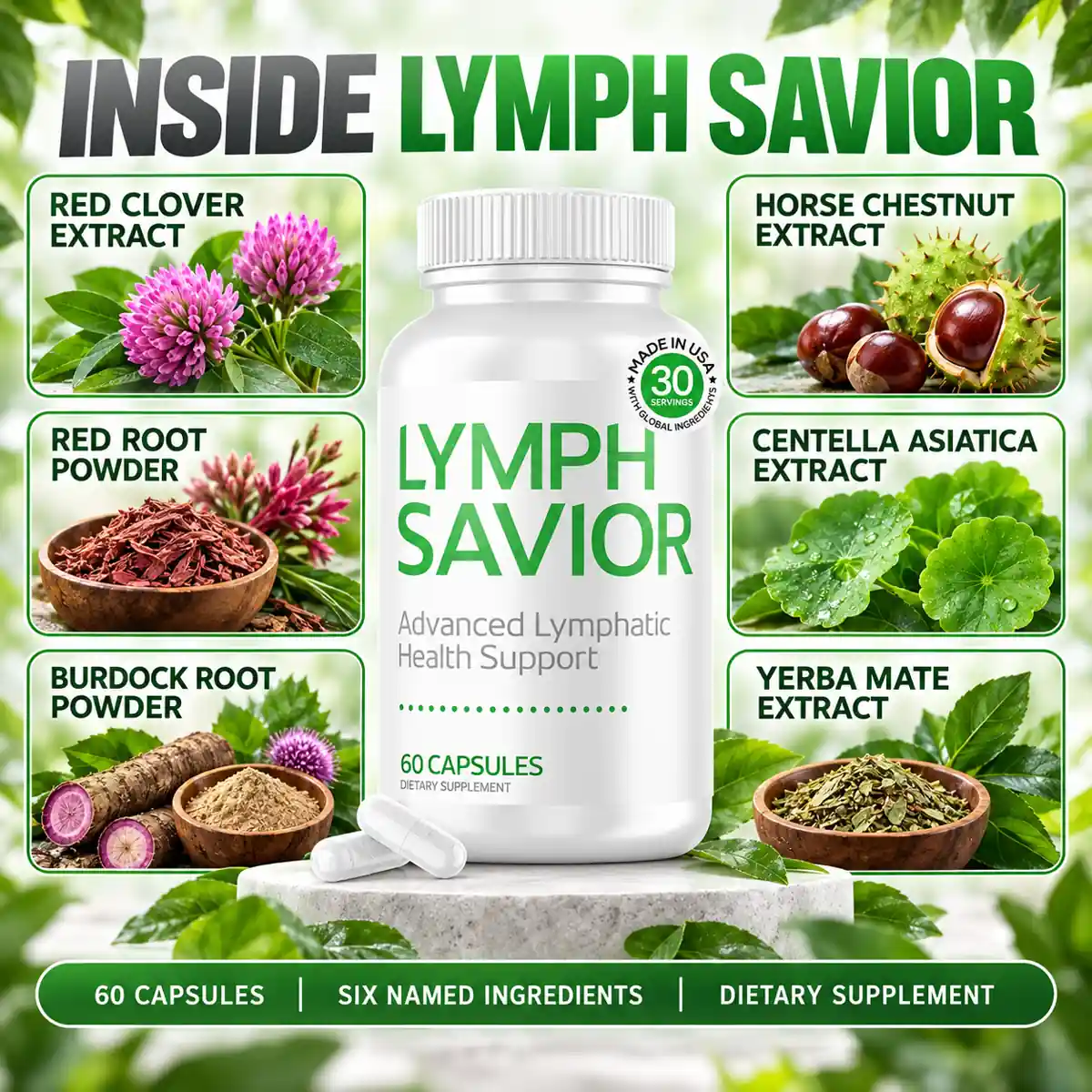
This website's own ingredients page lists a Latin name beside every one of the six botanicals, including Ceanothus americanus beside red root. That binomial is this site's own addition, arrived at the same way the rest of this page's sourcing works: by treating the plant's documented history as a lymphatic folk remedy, and the handful of papers that history leads to, as the identifying evidence. The brand's own named list, the one printed in the pack and carried onto the sales page, gives this ingredient as Red Root Powder and nothing more — no genus, no species, no family. Every other named botanical on that same list carries at least a plant part in parentheses, and three of the six — horse chestnut, centella asiatica and yerba mate — carry a full Latin binomial as well. Red root, along with red clover and burdock, is named by common name alone.
Red clover and burdock survive that gap without much practical risk, because Trifolium pratense and Arctium lappa are overwhelmingly the dominant plants those two common names refer to in herbal commerce; a shopper typing either name into a search engine lands on the right plant almost every time. Red root is a different case, and the rest of this article explains why.
Three plants, one common name
English common names for plants are not regulated, and red root or redroot has attached itself, independently, to at least three botanically unrelated species over the course of American usage. None of the three shares a family with either of the others.
| Plant | Family | What it actually is | Lymphatic or alterative tradition? |
|---|---|---|---|
| Ceanothus americanus | Rhamnaceae (buckthorn family) | A North American shrub, also called New Jersey tea | Yes, documented since at least 1868 |
| Amaranthus retroflexus | Amaranthaceae (amaranth family) | A common farm and garden weed, also called redroot pigweed | No; grown as a nuisance weed and occasionally a grain |
| Lachnanthes caroliniana | Haemodoraceae (bloodwort family) | A wetland plant native to the eastern U.S. coastal plain, also called Carolina redroot | No; valued chiefly as a native wetland and ornamental species |
Three families, three growth habits, three entirely different reasons to exist. The one thing they share is the two words a shopper is most likely to type into a search box.
Ceanothus americanus: the one this website identifies
This website's prior reporting on this ingredient traces its entire documented medical-literature footprint to two papers: an 1868 note in the Atlanta Medical and Surgical Journal describing Ceanothus americanus specifically under the name Red Root, New Jersey Tea, and a 1997 phytochemistry paper from the University of Iowa that isolated antimicrobial compounds from the same species. Both papers identify the plant by its binomial, Ceanothus americanus, even though the common name carried in both titles is simply red root. That 1868 note is the earliest documented source this desk has found connecting any plant called red root to lymphatic folk use, and it is the reason this website treats Ceanothus americanus, rather than either of the other two candidates below, as the plant this label intends.
Amaranthus retroflexus: the farm weed sharing the name
Amaranthus retroflexus is one of the most common agricultural weeds in North America, found in disturbed soil, gardens and farm fields across the continent. Its common names, according to the U.S. Fish and Wildlife Service's own species page, include red-root amaranth, redroot pigweed and red-root pigweed, a direct reference to the reddish colour of its taproot. It has no documented history as a lymphatic or alterative herb in the sources this desk has checked; where it appears in herbal or agricultural writing, it is discussed either as a nuisance weed or, in some cultures, as a minor grain and leaf-vegetable plant, never as the basis for a lymphatic-support formula. A shopper who searched red root and landed on this species would be looking at the correct common name attached to the wrong plant entirely.
Lachnanthes caroliniana: the wetland plant also called redroot
Lachnanthes caroliniana, native to wetlands along the eastern United States coastal plain, is commonly known as Carolina redroot, per its own U.S. Fish and Wildlife Service species profile, and is sometimes shortened to simply redroot in regional usage. It is a plant of ecological and horticultural interest — valued in native plant gardening and wetland restoration for its distinctive woolly yellow flowers and namesake red rhizome — rather than a documented herbal medicine. Like Amaranthus retroflexus, it shares the common name and nothing else with the plant this label's own context points to.

Read red root's own evidence record in full
Two papers, one from 1868, is the entire PubMed footprint for Ceanothus americanus — once the naming is settled, this is what the evidence actually says.
One, three and six-bottle packs · price set at checkout · 60-day money-back guarantee
Order Lymph Savior From This OutletLot LYM-26/LY-5684 · two a day, 60 to a bottle · ships from the United States
Why this particular name collision is worth flagging
Name collisions among common plant names are not rare, but most of them are low-stakes because context makes the intended plant obvious, or because only one of the colliding species has any history in herbal commerce at all. Red root is unusual because two of its three candidates — the farm weed and the wetland ornamental — are plausible enough as search results that a reader doing their own homework on this ingredient, rather than relying on this website's identification, has a real chance of researching the wrong plant's safety profile, chemistry or interactions and walking away with information that has nothing to do with what is actually in this capsule. A reader who searched red root safety and found material about Amaranthus retroflexus (which, notably, can accumulate nitrates and oxalates at levels of agricultural concern in livestock forage) would be reading about a real hazard attached to the wrong plant for this product, not a hazard that applies to Ceanothus americanus.
How this website resolves which plant is meant
This desk's identification of red root as Ceanothus americanus rests on three converging points rather than on any single authoritative source, because none exists in the brand's own materials. First, Ceanothus americanus is the only one of the three candidates with any documented history as a lymphatic or alterative botanical, which matches the strapline this entire product is sold under. Second, the plant photograph used in the brand's own ingredient graphic — a cut, reddish-brown root beside a sprig of small, pale pink flowers — is consistent with Ceanothus americanus's appearance and inconsistent with either Amaranthus retroflexus (a broadleaf weed with no comparable flower spike) or Lachnanthes caroliniana (a grass-like wetland plant with yellow, woolly blooms). Third, the only medical-literature paper trail this desk has been able to locate for any plant called red root traces specifically to Ceanothus americanus. None of the three points is conclusive on its own; together, they are the basis for every other article on this blog that discusses this ingredient.
The transferable lesson
The practical habit this case teaches travels well beyond this one bottle. Whenever a supplement label names an ingredient by common name only, with no binomial anywhere in the brand's own materials, that absence is itself a piece of information worth noticing, not a neutral gap. The National Center for Complementary and Integrative Health's own herb index exists partly to solve exactly this problem, cross-referencing common names to the species they are more precisely known by. Where a product's own materials do not supply that cross-reference, a shopper doing independent research is better served starting from context — what tradition or use case the ingredient is sold under — than from the common name alone, because as this case shows, the common name by itself can point in three different botanical directions at once.
Red root is a common name, not a species. Three unrelated plants answer to it, and only the plant history and the formula's own context say which one this label means.
References
- Phares DL. Ceanothus Americanus: Red Root, New Jersey Tea. Atlanta Medical and Surgical Journal. 1868;9A(3):129-131. https://pubmed.ncbi.nlm.nih.gov/35824507/
- Li XC, Cai L, Wu CD. Antimicrobial compounds from Ceanothus americanus against oral pathogens. Phytochemistry. 1997;46(1):97-102. https://pubmed.ncbi.nlm.nih.gov/9276981/
- Red-root Amaranth (Amaranthus retroflexus). U.S. Fish and Wildlife Service. https://www.fws.gov/species/red-root-amaranth-amaranthus-retroflexus
- Carolina Redroot (Lachnanthes caroliniana). U.S. Fish and Wildlife Service. https://www.fws.gov/species/carolina-redroot-lachnanthes-caroliniana
- Herbs at a Glance. National Center for Complementary and Integrative Health, National Institutes of Health. https://www.nccih.nih.gov/health/herbsataglance